

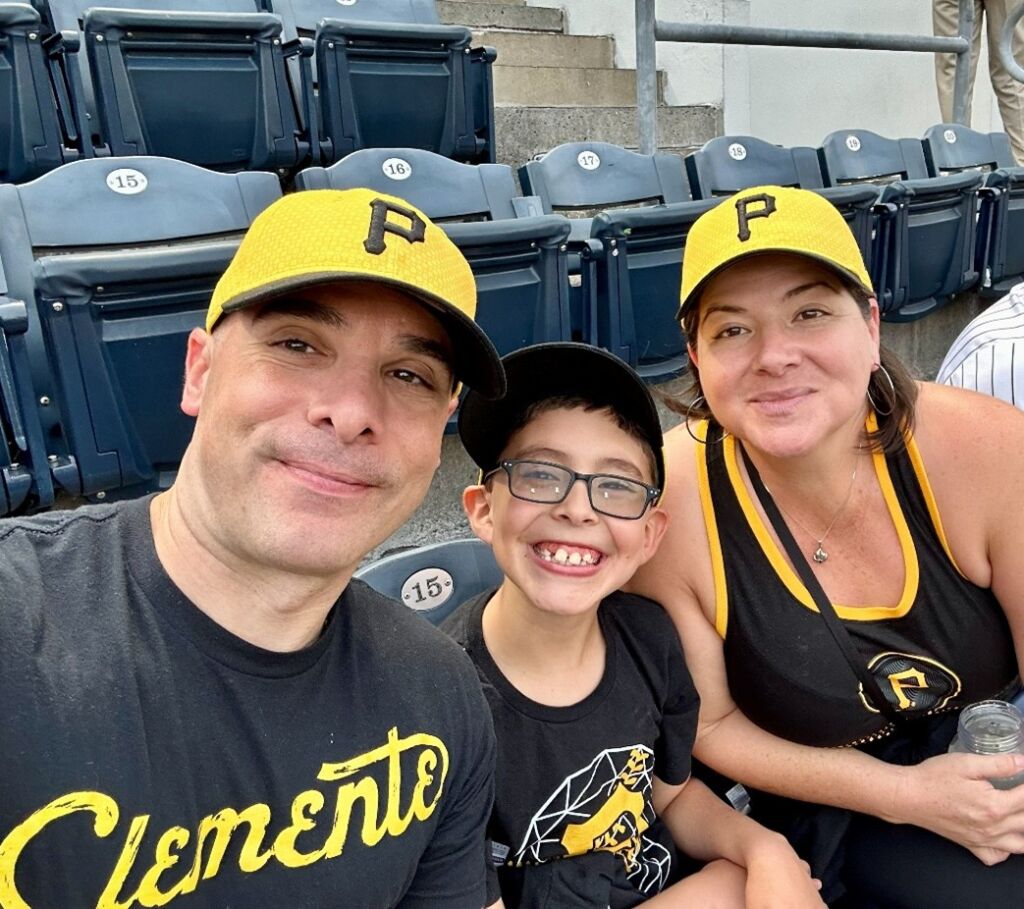
Meet Dr. Monica Mendez, a passionate advocate for equity and community empowerment who calls Plum Borough home. Alongside her husband, Jose Monroy, and their 11-year-old son, Carter, Monica brings her dedication to social justice into both her professional and personal life as the director of programs at the Latino Community Center in Pittsburgh. In this role, she has spent more than two decades in the nonprofit sector championing human rights and systemic change.
How does your own background or identity influence the work you do with Latine families? Do you see parts of your own story in the families you serve? How does that shape your work?
My family and I immigrated to the United States over 40 years ago, and, unfortunately, I continue to see many of the same systemic barriers and individual prejudices that I experienced affecting our youth today. While my parents did their best to shield us from those challenges, communities that society marginalizes inevitably bear the brunt of systemic inequities. Because of this, I feel a deep sense of empathy and connection with the families we serve. Progress requires both advocacy and persistence, and it strengthens my commitment to creating more equitable opportunities for the next generation.
What does work/life balance look like for you right now? Has that changed over time?
I’m not sure true work-life balance ever fully exists, but my spouse and I do our best to create a sense of equilibrium. Having an employer that values flexibility and recognizes the importance of family makes an enormous difference. Without that flexibility, maintaining time for both work and family would be far more challenging. As my son Carter has grown and become more involved in activities — especially baseball — our schedules have naturally shifted. The ability to leave work early to attend his games is something my spouse and I both deeply value.
What do you do to recharge or stay grounded, especially at times when the emotional labor of your work and parenting feels heavy?
I give myself time to do what I enjoy doing, which is usually working with my hands. I enjoy yard work, woodworking and metalworking. Although I still struggle with feeling guilty for taking time for myself, I’ve found that I end up feeling more fatigued and overwhelmed when I don’t give myself that time. It becomes even more crucial when difficult times are had both in the workplace and at home.
What kind of support do you wish was more accessible for moms in your position, especially those doing community work?
As a parent and particularly as a woman, I wish there were greater societal understanding and structural support for the responsibilities that come with parenting. Too often, caregiving is perceived as a lack of professional commitment rather than a reflection of one’s dedication and capacity to balance multiple roles. To truly support mothers, we must recognize and honor the full scope of women’s labor — both in their professional and personal spheres — and create systems that value and sustain their contributions across all areas of life.
What are the values or life lessons you most hope to pass on to your son?
I hope to instill in my son a strong sense of social justice grounded in kindness, empathy and integrity. I want him to understand that respect is something to be both earned and extended when deserved, and that standing up for what is right is a responsibility. I want him to care deeply, even about issues that may not directly affect him, and to recognize his connection to his community, to animals, and to the environment. My greatest hope is that he develops the confidence, compassion and resilience to rise above adversity and to love himself, his family and his community with pride and purpose.
How do you talk to Carter about justice, kindness or systems of inequality in a way that feels age-appropriate but real?
It’s not always easy to navigate these conversations, but we’ve been intentional about exposing our son to the realities of the world from an early age through books and open dialogue. Fortunately, there are now many children’s books that address complex topics — such as justice, kindness and inequality — in age-appropriate and accessible ways. When I’m uncertain about how to approach a specific topic, I reach out to colleagues and professionals for guidance. It’s important to recognize that parents don’t have all the answers and that our perspectives can be shaped by our own experiences. Lastly, we make a conscious effort to expose our son to diverse languages, ideas, and experiences so he can develop a well-rounded worldview — one that enables him to think critically and understand issues through a lens of truth and empathy.
If your son could remember just one thing about how you showed up in the world, what would you want it to be?
I would want Carter to remember that I never stayed silent in the face of injustice — that I consistently chose to stand up for what was right while treating others with kindness and empathy. I showed up, I stood up and I did so with integrity.
FAMILY FAVORITES:
Weekend Activity: Baseball!
Sports Team: Pirates and UCF
Family Movie: “Free Guy”
Date Night Plans: Order in and a scary movie
Family Restaurant: Madero Cantina (Murrysville)
Carrie Woodard is a National Certified Counselor, National Certified School Counselor and a Pittsburgh mama of two.

