

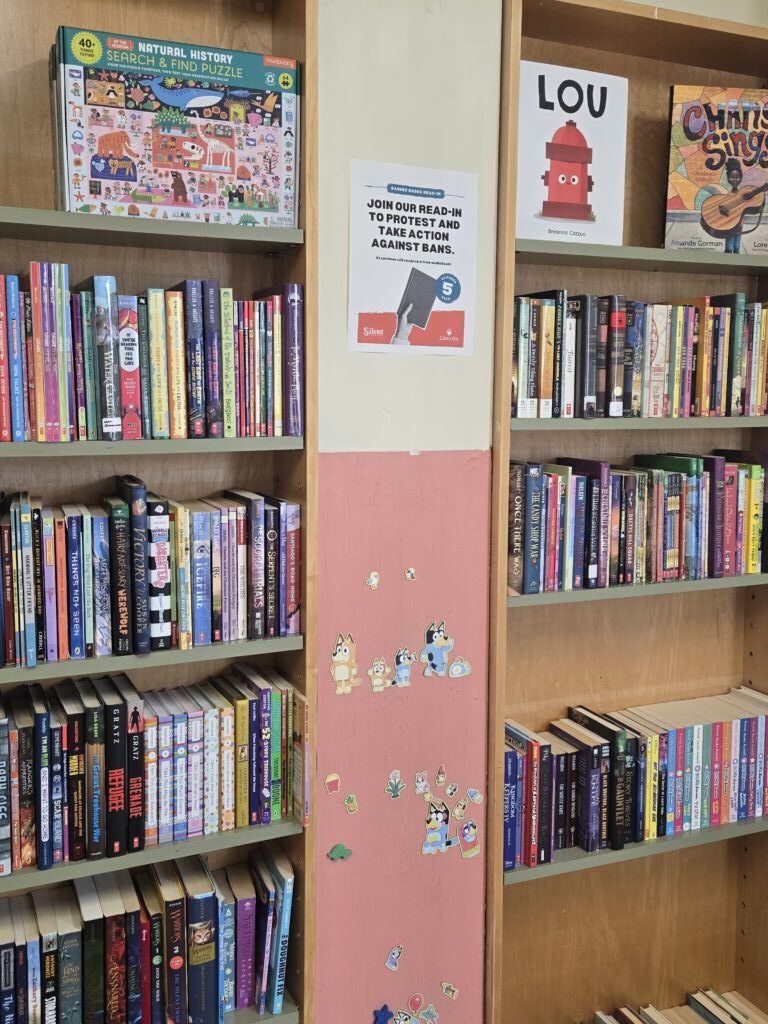
available at Blythe Books (Ann K. Howley)
In a large-scale study published in the journal iScience in 2025, researchers analyzed data from more than 200,000 individuals in the American Time Use Survey and found that between 2003 and 2023, daily reading for pleasure in the United States declined by more than 40%, or approximately 3% per year. When the results of this study were released, many educators, legislators and parents reacted with alarm, knowing that reading for pleasure has long been recognized as an important means of supporting mental health, empathy and creativity.
The good news is that in Pennsylvania standardized reading test scores improved in 2024 and Pennsylvania schoolchildren consistently score slightly higher than the national average. However, the leaders of many school districts believe that students lost so much ground during the pandemic that they are still trying to meet appropriate levels of reading comprehension.
In addition to these concerns, there’s a concern that the digital age has ushered in new reading tools like e-books and e-readers that allow readers to access books on digital devices rather than reading traditional print books.
Altogether, these current trends and statistics raise the question, “Will new generations of kids someday give up print books entirely?
So, are print books going away?
It does not appear likely.
According to a recent Pew Research Center study on book consumption and book formats, the most popular reading format for both adults and children is still traditional print books.
Lizzie McCoy, owner of Blythe Books in Brentwood, agrees.
“Print media is definitely having a resurgence,” McCoy says.
Even the youngest readers who come into her bookstore still love to hold books. “Little kids still get excited to see books,” she says.
And since Blythe Books is close to an elementary school, a middle school and the high school in the Brentwood Borough School District, where kids walk to school, McCoy sees a lot of kids wander into her store on their way home after school.
“As kids get older, there is less excitement,” she says. “But middle and high school students still enjoy coming into the store.”
McCoy tells of four middle school boys who once came into her bookstore.
“They all had attitudes like they were ‘too cool’ for this place, but when they started browsing and recognized books that they had read before, all of a sudden, they got excited. By the time they left, we were all friends,” McCoy says with a smile.
“There has also been a huge uptick in audiobooks,” she points out.
For children, approximately 3 through 8 years old, screen-free audio players, like the Yoto and Toniebox systems, which play stories, music, games and more, are very popular.
“The great thing about an audiobook is that it’s a good way to fit reading into the day,” McCoy says. “A child could be doing something quiet, like drawing or doing beadwork with an audiobook playing in the background. It helps children decompress.”
“Do you like to read?”
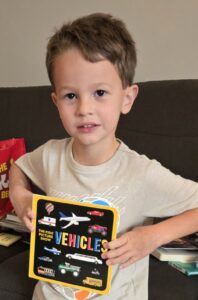
Five-year-old Connor Reitnauer, who lives in Bethel Park, responds to this question with an emphatic, “YEP.”
Connor’s favorite book is called “Vehicles,” and with a serious expression on his face, he says, “Vehicles, like trucks, airplanes and buses, are important.”
His older brother, Patrick, who is 8, is a bit more circumspect about reading. “Everything is boring,” Patrick says, rolling his eyes, like a typical 8-year-old boy.
His mother, Megan Reitnauer, takes exception.
“I know there are books you like!” she counters, pointing to the stack of some of his favorite books piled on the couch, including several on the topic of dinosaurs.
Reitnauer explains that her boys generally read only print books, unless they travel or go on a road trip, and then they use tablets, which came in handy when the family was stuck in an airport for six hours during the summer.
When 16-year old, Bryce Kautzman, who attends Bethel Park High School, considers whether or not he likes to read, he responds honestly.
“It depends,” he says.
Bryce admits that he enjoys reading if it’s a genre that interests him, like mysteries.
“Not necessarily murder mysteries,” he explains. “I like mysteries where they have to find something.”
Bryce’s favorite book series is “Diary of a Wimpy Kid.”
“I would always wait for the new one to come out,” he says.
He also states that he never reads e-books.
“There is something about print books. I think they are easier to read,” he says.
Bryce’s 13-year-old sister is an avid reader, although among her friends, she estimates that half do and half don’t like to read for fun.
Her favorite genres are fantasy, sci fi and historical or realistic fiction and her favorite series is the Warrior series—which is about cats.
What books are popular with local kids?
Lizzie McCoy says that a lot of kids come into her store with their parents. Younger kids love book series, like The Magic Treehouse series, which is popular among kids ages 6 to 10.
For older kids, books like “The Hunger Games” and “City of Bones” are popular.
“Scythe is a very popular fantasy book and Jenny Han’s “The Year I Turned Pretty” sells well. Especially if the kids saw movies from the books — that really sparks their interest to read them,” McCoy says.
Why should kids read print books?
Experts say there is no better way to instill a love of reading than to cuddle with a child and read a book. The tactile experience of holding a book, turning its pages and sharing it with a child is a valuable tool in the childrearing toolkit. Story time gives parents, caretakers and teachers the opportunity to explore and discover new things with kids. Words, ideas and illustrations, without blinking lights, games or technology, are the bare bones foundation of reading. The best way to set a child up for lifetime learning success is to show them the power and magic of books at an early age.
“These reading experiences can set the state for later reading success,” Julia Parish-Morris, a post-doctoral fellow at the University of Pennsylvania, told Scholastic, the world’s largest publisher and distributor of children’s books in an article about e-book vs. print books on the Scholastic website.
Why should kids read digital books?
There are good reasons why many school districts provide tablets and computers for students. In this digital world, kids become immersed in technology from an early age. A Pew Research Center survey published in October found that a majority of parents of kids ages 11 to 12 reported that their child has a smartphone. Kids are far more familiar with technology today that any previous generation.
With this in mind, it is easy to understand how new generations of kids feel comfortable using digital devices for learning and leisure.
The Center for Literacy at the University of Akron has been studying how to integrate e-readers into classroom and have found that e-book animation and audio helps young kids identify printed words. Researchers have observed that when using digital devices, the kids were “extremely engaged.”
Kids also enjoy the interactive aspect of reading when, for example, printed words light up, and they have the ability to zoom in on unfamiliar words or clink links that help them with better comprehension. E-books can reinforce what children learn and are fun to use, too.
Are print or ebooks better for kids?
There are benefits to both, and it’s not necessary to quality one over the other. If your child prefers print books, then support their interest by visiting bookstores and libraries and encouraging their interest in reading. If your child likes to read or listen to books on an e-reader or other device, then find ways to make more books and stories available to them.
Public libraries also provide free audiobooks and e-books through apps like Libby and Sora. Websites like Project Gutenberg and LibriVox are good sources for free books. Also check out Storyline Online, which is a nonprofit literacy website that features videos of celebrities reading children’s books aloud.
Ultimately, the best thing a parent can do is encourage their children to read. It’s never too late. Reading is not just a life skill. According to the recent American Time Use study, “Reading has a wide range of benefits for literacy, employment and health, as well as promoting cultural understanding.”
Print books are not going away
McCoy remembers the effect the Harry Potter books had on the generation of kids almost 30 years ago. It was a cultural phenomenon. Even kids who had never read before became readers because they wanted to follow the boy wizard in all his adventures.
She hopes that her books will lead kids to be lifetime readers and believes that one of the most important reasons that print books will never go away is that books give both adults and children pride of ownership.
“There is a joy in owning physical books,” she says.
And on this, it appears that both adults and children agree.

