

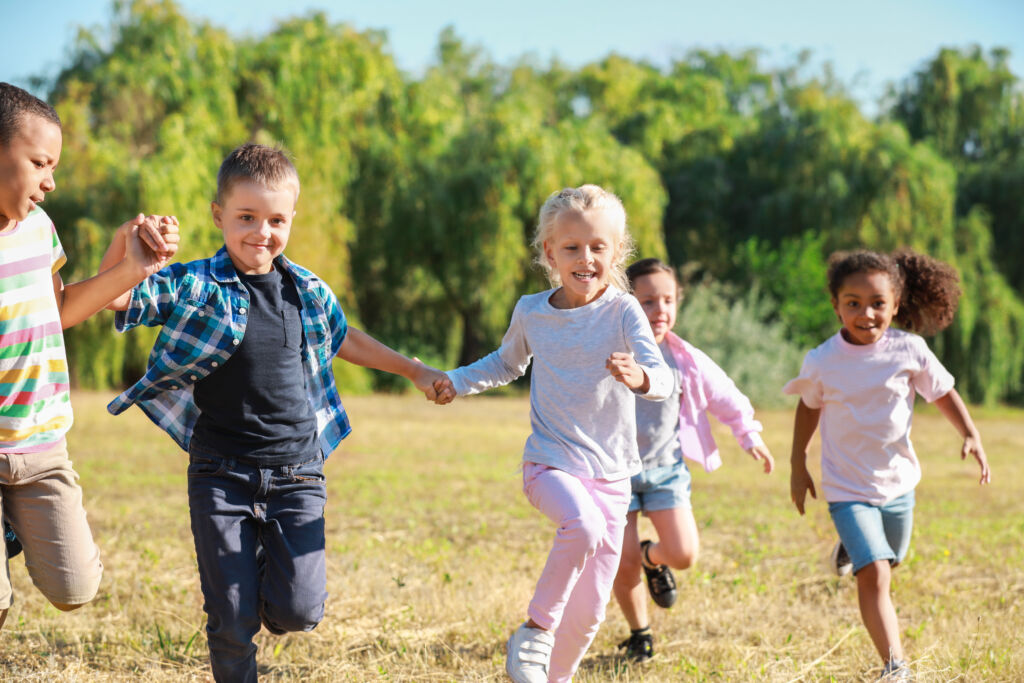
By May and June, summer break and graduation may be the first thing on kids’ minds when thinking about the remainder of their school year. But many schools have another spring tradition to look forward to: field day!
The tradition of having a school day dedicated to sports and athletic competitions is one practiced around the world. In the United States, it’s one of the oldest school traditions. While it is difficult to determine where and when the first field day was held, they had become common in schools by the end of the 19th century, owing to both a new interest in widespread youth education and the rise of the early fitness movement around the same time.
Students may look forward to field day as an opportunity to spend a day playing fun games instead of having to do classwork, but it has a larger purpose: in addition to physical education for kids, it can improve their social skills and build a sense of solidarity and teamwork at their school. Some schools even let parents and community members volunteer to set up and run games during field day, giving the wider community a chance to get involved.
The Games
Field days rarely incorporate traditional sports like baseball, soccer or football, opting instead for relay races, tugs-of-war and other low-stakes physical activities and games. Many field day games have additional benefits beyond just getting kids to exercise, working on mental skills involving strategy and physics. Here are some common games:
Tug-of-War: Pullers have to consider factors like the amount of people on each side of the rope, who among them is the strongest and how hard and when they should pull the rope to win. It can also serve as great stress relief.
Egg and Spoon Race: While most races are about going as fast as you can, the egg and spoon race actively discourages that approach. As students carry an egg or other round, light object on a spoon across the field, they learn patience, how to focus on a specific task and skills in hand-eye coordination.
Three-Legged Race: Pairs of students bound together by one leg are required to communicate with each other, paying attention to how their partner is moving, as one person moving ahead without telling the other can cause both halves to fall over or slow down.
Sponge Relay: Since field days are often held on hot days, the sponge relay helps kids cool down. Building teamwork and communication skills, players have to ensure that the sponge doesn’t lose a large amount of water as they pass it off to each person.
Local Field Day Traditions
Many Pittsburgh-area schools, most commonly elementary schools, hold field days of their own. Offerings can vary by school, but the goal of these events is the same.
The North Hills School District holds an annual Fifth Grade Track and Field Day. Fifth grade students from the district’s four elementary schools — Highcliff Elementary School, McIntyre Elementary School, Ross Elementary School and West View Elementary School — compete against each other in traditional track and field activities like races, long jump competitions and discus.
Field days aren’t just for young children, either. Some community organizations hold field day events that are fun for the whole family and encourage older teens and even parents to get involved. The YMCA of Greater Pittsburgh holds its annual Family Field Day in July, featuring competitions and crafts across all of its Pittsburgh-area locations.
Field Day Fun Facts
Military Roots
The term “field day” was originally used to describe a day when the military would practice field exercises.
National Sports Day
In some countries, such as India, Iran and Malaysia, field days are held to celebrate their National Sports Day.
Undokai
Sports festivals (undokai) are common at schools in Japan. The first took place in Tokyo in 1874 and included pole vaulting and pig-chasing as events.

